


Hair Restoration
Provider evaluation · Appropriate testing · Ongoing monitoring
Hair loss is the visible symptom. The real question is why it is happening. T Clinics USA looks at the pattern, timeline, hormones, health changes, medications, weight-loss history, and other potential contributors before deciding which hair-restoration approach actually fits.
Hair loss is the visible symptom. The real question is why it is happening. T Clinics USA looks at the pattern, timeline, hormones, health changes, medications, weight-loss history, and other potential contributors before deciding which hair-restoration approach actually fits.
HORMONE OPTIMIZATION
PEPTIDE THERAPY
MEN'S & WOMEN'S HEALTH
IV THERAPY
HORMONE OPTIMIZATION
PEPTIDE THERAPY
MEN'S & WOMEN'S HEALTH
IV THERAPY
HORMONE OPTIMIZATION
PEPTIDE THERAPY
MEN'S & WOMEN'S HEALTH
IV THERAPY
TWO STEPS TO A FREE CONSULTATION
The signs are easy to dismiss. The cause is worth checking.
These are common experiences people bring to us. Two steps, about a minute, and a licensed provider's team takes it from there. Only a provider and lab work can determine what's behind them.
Step 1 of 2
Check off what sounds familiar
Tap every item below that applies to you. Tap it again to unselect. Check off as many as you like, or none at all.
Step 2 of 2
Choose your consultation form
Select a location below, then continue to the short consultation form.
Ready to Talk With Our Team?
Your next step is a consultation with the T Clinics USA team. We’ll use the information you provide to help coordinate the appropriate next step.
It only takes a moment to send your request.
Choose where you'll complete the short consultation form.
This is general information, not a medical assessment or diagnosis. A licensed provider determines whether any condition is present and whether treatment is appropriate. Results vary by individual.
0 items checked off
TWO STEPS TO A FREE CONSULTATION
The signs are easy to dismiss. The cause is worth checking.
These are common experiences people bring to us. Two steps, about a minute, and a licensed provider's team takes it from there. Only a provider and lab work can determine what's behind them.
Step 1 of 2
Check off what sounds familiar
Tap every item below that applies to you. Tap it again to unselect. Check off as many as you like, or none at all.
Step 2 of 2
Choose your consultation form
Select a location below, then continue to the short consultation form.
Ready to Talk With Our Team?
Your next step is a consultation with the T Clinics USA team. We’ll use the information you provide to help coordinate the appropriate next step.
It only takes a moment to send your request.
Choose where you'll complete the short consultation form.
This is general information, not a medical assessment or diagnosis. A licensed provider determines whether any condition is present and whether treatment is appropriate. Results vary by individual.
0 items checked off
Hair Loss Is What You See. The Pattern Behind It Is What Matters.
Hair loss usually announces itself in small ways. More hair in the shower. A part that looks wider than it used to. A crown that suddenly shows more scalp in photos. A hairline that seems to move a little farther back every year. Or shedding that feels like it started almost overnight. The instinct is usually to ask: “What should I take for hair loss?” But that skips the most important question. Why is the hair changing in the first place? Hair loss is not one condition. Hereditary pattern loss can gradually shrink follicles over time. Hormonal changes can alter the way hair grows and sheds. Rapid weight loss, illness, surgery, major stress, or nutritional changes can push more hairs into a shedding phase. Thyroid problems, medications, and other health factors can also enter the picture. Think of hair loss like a warning light on a dashboard. Two cars can show the same light for completely different reasons. Replacing the same part in both cars would make no sense. Hair restoration works the same way. A receding hairline in a man may require a very different strategy from diffuse shedding in a woman after major weight loss. The visible problem may look similar. The biology behind it may not be. That is why the first goal at T Clinics USA is not to sell everyone the same product. It is to identify the pattern, understand what may be driving it, and build the treatment conversation around the cause.
Hair Loss Is What You See. The Pattern Behind It Is What Matters.
Hair loss usually announces itself in small ways. More hair in the shower. A part that looks wider than it used to. A crown that suddenly shows more scalp in photos. A hairline that seems to move a little farther back every year. Or shedding that feels like it started almost overnight. The instinct is usually to ask: “What should I take for hair loss?” But that skips the most important question. Why is the hair changing in the first place? Hair loss is not one condition. Hereditary pattern loss can gradually shrink follicles over time. Hormonal changes can alter the way hair grows and sheds. Rapid weight loss, illness, surgery, major stress, or nutritional changes can push more hairs into a shedding phase. Thyroid problems, medications, and other health factors can also enter the picture. Think of hair loss like a warning light on a dashboard. Two cars can show the same light for completely different reasons. Replacing the same part in both cars would make no sense. Hair restoration works the same way. A receding hairline in a man may require a very different strategy from diffuse shedding in a woman after major weight loss. The visible problem may look similar. The biology behind it may not be. That is why the first goal at T Clinics USA is not to sell everyone the same product. It is to identify the pattern, understand what may be driving it, and build the treatment conversation around the cause.

START WITH THE PATTERN
START WITH THE PATTERN
Do Not Treat Every Type of Hair Loss Like the Same Problem.
Do Not Treat Every Type of Hair Loss Like the Same Problem.
Do Not Treat Every Type of Hair Loss Like the Same Problem.
Pattern hair loss, diffuse shedding, hormone-related changes, rapid-weight-loss shedding, and other forms of hair loss can look similar at first. The more useful strategy is to identify what changed, what pattern is developing, and which treatment options actually match that situation.
Pattern hair loss, diffuse shedding, hormone-related changes, rapid-weight-loss shedding, and other forms of hair loss can look similar at first. The more useful strategy is to identify what changed, what pattern is developing, and which treatment options actually match that situation.
Pattern hair loss, diffuse shedding, hormone-related changes, rapid-weight-loss shedding, and other forms of hair loss can look similar at first. The more useful strategy is to identify what changed, what pattern is developing, and which treatment options actually match that situation.
PATTERN · CAUSE · TREATMENT FIT · HAIR STRATEGY
PATTERN · CAUSE · TREATMENT FIT · HAIR STRATEGY
Related Care & Treatments
Hair Loss On GLP-1

Hair Loss On GLP-1
Hair shedding can become part of the GLP-1 weight-loss conversation, but the reason is not always as simple as “the medication is making my hair fall out.” Rapid weight loss, reduced calorie or protein intake, nutritional changes, metabolic stress, medication exposure, and an underlying hair-loss pattern can overlap. The first step is understanding which pattern is actually happening.
Explore Hair Loss On GLP-1
Hair Restoration for Women

Hair Restoration for Women
Sometimes the part looks wider. The ponytail feels smaller. More hair collects in the shower. The change may be gradual — or follow stress, weight loss, pregnancy, illness, medication changes, perimenopause, or menopause.
Explore Hair Restoration for Women
Hair Restoration For Men

Hair Restoration For Men
Male pattern hair loss is treated at T Clinics USA in Naples, Fort Myers, and Coral Springs. Finasteride and minoxidil are the FDA-approved foundation, and PRP, GHK-Cu copper peptide, and nutrient support, including biotin, are also part of the plan when appropriate. If you are also on testosterone therapy, your provider factors that into your plan. Results vary by individual.
Explore Hair Restoration For Men
Hair Loss Is A Symptom, Not A Diagnosis
Every hair restoration plan at T Clinics USA starts from a cause, established by examination and bloodwork at one of three Florida clinics.
Hair Loss Is A Symptom, Not A Diagnosis
Every hair restoration plan at T Clinics USA starts from a cause, established by examination and bloodwork at one of three Florida clinics.
Same practice
GLP-1 weight management and hair restoration run under one roof, so shedding during a weight loss program is addressed by providers who share your chart.
Same practice
GLP-1 weight management and hair restoration run under one roof, so shedding during a weight loss program is addressed by providers who share your chart.
Cause first
Thyroid function, iron, ferritin, and hormone levels are reviewed before a treatment plan is written.
Cause first
Thyroid function, iron, ferritin, and hormone levels are reviewed before a treatment plan is written.
Women too
Female pattern hair loss and post-weight-loss shedding are treated here, using medications appropriate for women.
Women too
Female pattern hair loss and post-weight-loss shedding are treated here, using medications appropriate for women.
How It Works
Hair Loss Is the Symptom. The First Job Is Finding the Pattern.
How It Works
Hair Loss Is the Symptom. The First Job Is Finding the Pattern.
01
WHEN THE MIRROR STARTS TELLING A DIFFERENT STORY
A wider part, more hair in the shower, or a hairline that looks different in photos can mean very different things.
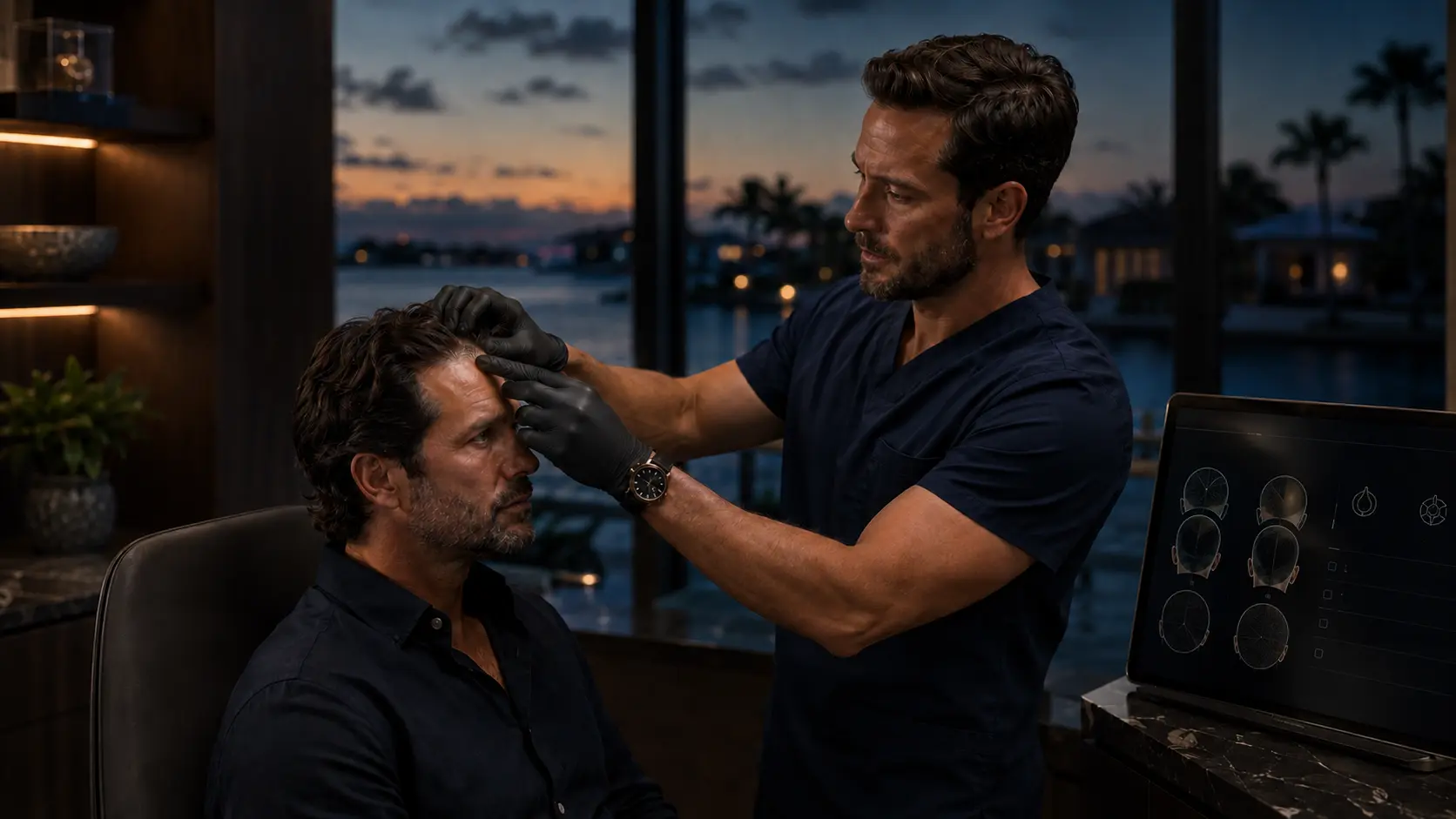
Hair loss usually becomes real before it becomes “medical.” It is the extra hair in the shower drain. The part that looks wider under bathroom lighting. The photo where the hairline suddenly looks farther back than you remember.
But those clues do not all point to the same cause. Pattern loss behaves differently from diffuse shedding, and shedding after rapid weight change, stress, low iron, thyroid dysfunction, or another shift in the body can look similar at first. That is why T Clinics starts with the pattern, timeline, health history, and appropriate bloodwork instead of treating every thinning head of hair like the same problem.
Hair loss is the warning light. The first job is figuring out what is actually turning it on.
01
WHEN THE MIRROR STARTS TELLING A DIFFERENT STORY
A wider part, more hair in the shower, or a hairline that looks different in photos can mean very different things.
Hair loss usually becomes real before it becomes “medical.” It is the extra hair in the shower drain. The part that looks wider under bathroom lighting. The photo where the hairline suddenly looks farther back than you remember.
But those clues do not all point to the same cause. Pattern loss behaves differently from diffuse shedding, and shedding after rapid weight change, stress, low iron, thyroid dysfunction, or another shift in the body can look similar at first. That is why T Clinics starts with the pattern, timeline, health history, and appropriate bloodwork instead of treating every thinning head of hair like the same problem.
Hair loss is the warning light. The first job is figuring out what is actually turning it on.

02
MATCH THE TREATMENT TO THE PATTERN
The point is not to hand everyone the same prescription. It is to understand what kind of hair-loss problem is actually present.
Once the pattern is clearer, the treatment conversation gets more useful. Minoxidil may be used in men and women. Finasteride is generally used for men, while spironolactone may be part of a women’s treatment plan when appropriate. The right choice depends on the type of hair loss, medical history, medications, risks, and what needs to be monitored.
Think of it like fixing a leak. Painting over the water stain may make the ceiling look better for a while, but if you never identify where the water is coming from, you have not really solved the problem.
That is the difference between a one-click hair subscription and a clinical hair-restoration plan: the treatment should follow the pattern, not the marketing funnel.
02
MATCH THE TREATMENT TO THE PATTERN
The point is not to hand everyone the same prescription. It is to understand what kind of hair-loss problem is actually present.
Once the pattern is clearer, the treatment conversation gets more useful. Minoxidil may be used in men and women. Finasteride is generally used for men, while spironolactone may be part of a women’s treatment plan when appropriate. The right choice depends on the type of hair loss, medical history, medications, risks, and what needs to be monitored.
Think of it like fixing a leak. Painting over the water stain may make the ceiling look better for a while, but if you never identify where the water is coming from, you have not really solved the problem.
That is the difference between a one-click hair subscription and a clinical hair-restoration plan: the treatment should follow the pattern, not the marketing funnel.
03
WHEN WEIGHT LOSS AND HAIR SHEDDING COLLIDE
If shedding starts during a GLP-1 journey, the weight-loss plan and the hair conversation should not live in separate silos.
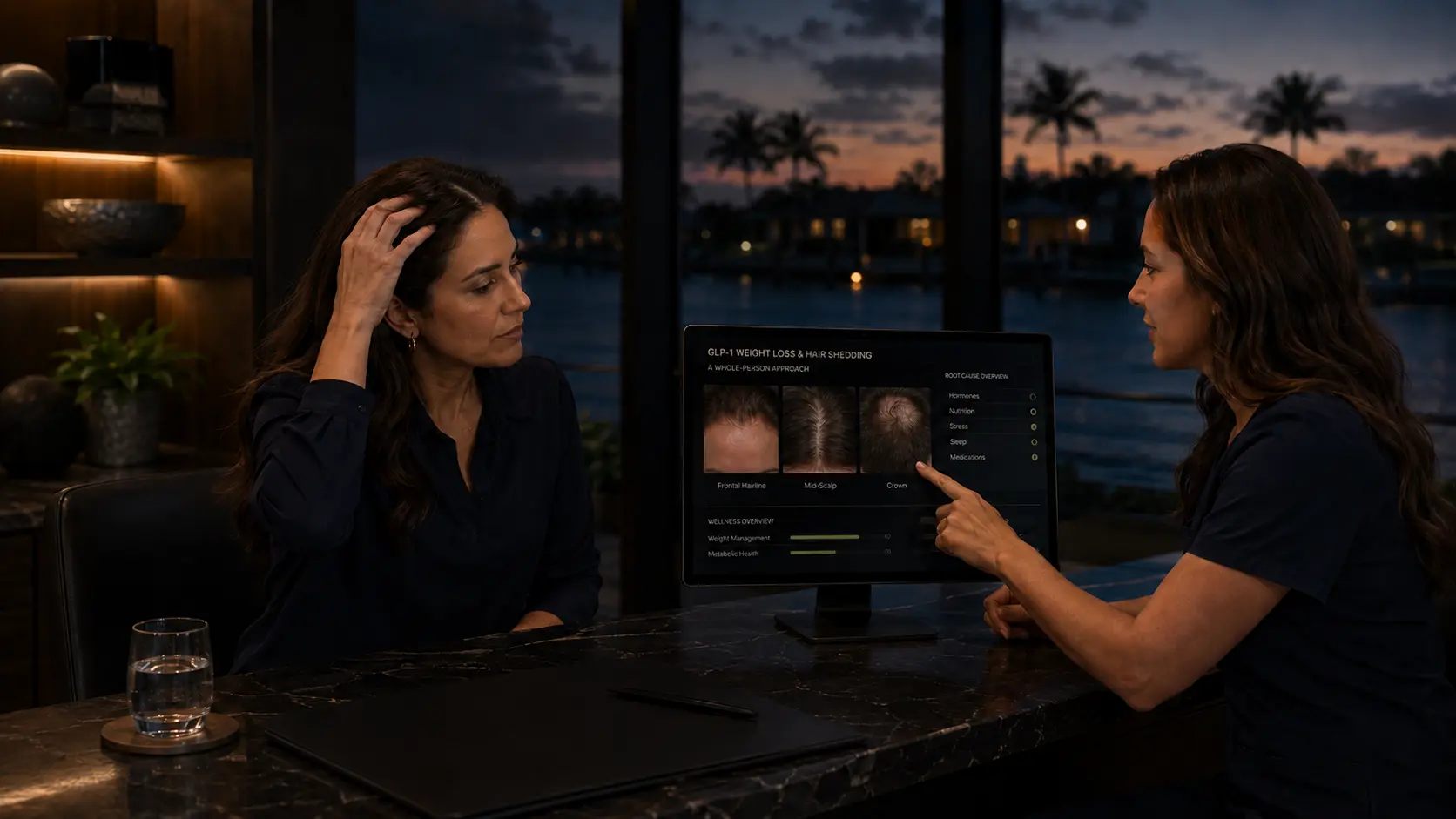
Someone can be thrilled with the scale and still panic when the shower drain starts filling up. Rapid weight change can be associated with diffuse shedding, which is why timing and context matter when hair loss begins during a GLP-1 program.
At T Clinics, that does not have to become a completely separate problem. The conversation can look at what changed, when the shedding began, what the labs show, and whether the pattern looks temporary, progressive, or related to something else.
The goal is not to promise regrowth. It is to stop guessing, understand what kind of hair-loss problem is actually present, and build the next step around that answer.
03
WHEN WEIGHT LOSS AND HAIR SHEDDING COLLIDE
If shedding starts during a GLP-1 journey, the weight-loss plan and the hair conversation should not live in separate silos.
Someone can be thrilled with the scale and still panic when the shower drain starts filling up. Rapid weight change can be associated with diffuse shedding, which is why timing and context matter when hair loss begins during a GLP-1 program.
At T Clinics, that does not have to become a completely separate problem. The conversation can look at what changed, when the shedding began, what the labs show, and whether the pattern looks temporary, progressive, or related to something else.
The goal is not to promise regrowth. It is to stop guessing, understand what kind of hair-loss problem is actually present, and build the next step around that answer.
You have questions, we have answers.
Why am I losing or thinning hair?
Why am I losing or thinning hair?
Can thinning hair grow back?
Can thinning hair grow back?
How do you decide which hair-loss treatment is right for me?
How do you decide which hair-loss treatment is right for me?
Is hair loss different in men and women?
Is hair loss different in men and women?
Can GLP-1 weight loss cause hair shedding?
Can GLP-1 weight loss cause hair shedding?
What treatments are commonly used for hair loss?
What treatments are commonly used for hair loss?
Request a Consultation