


Low Testosterone Symptoms
Provider evaluation · Appropriate testing · Ongoing monitoring
Low libido, fewer spontaneous erections, declining strength, fatigue, and changes in body composition can raise the question of low testosterone—but symptoms alone do not diagnose it. T Clinics USA combines the symptom pattern with repeat morning bloodwork to determine whether testosterone is actually part of the problem.
Low libido, fewer spontaneous erections, declining strength, fatigue, and changes in body composition can raise the question of low testosterone—but symptoms alone do not diagnose it. T Clinics USA combines the symptom pattern with repeat morning bloodwork to determine whether testosterone is actually part of the problem.
MORNING DRAW
CONFIRMED TWICE
TOTAL & FREE
SPECIFIC VS NON-SPECIFIC
MORNING DRAW
CONFIRMED TWICE
TOTAL & FREE
SPECIFIC VS NON-SPECIFIC
MORNING DRAW
CONFIRMED TWICE
TOTAL & FREE
SPECIFIC VS NON-SPECIFIC
TWO STEPS TO A FREE CONSULTATION
The signs are easy to dismiss. The cause is worth checking.
These are common experiences people bring to us. Two steps, about a minute, and a licensed provider's team takes it from there. Only a provider and lab work can determine what's behind them.
Step 1 of 2
Check off what sounds familiar
Tap every item below that applies to you. Tap it again to unselect. Check off as many as you like, or none at all.
Step 2 of 2
Choose your consultation form
Select a location below, then continue to the short consultation form.
Ready to Talk With Our Team?
Your next step is a consultation with the T Clinics USA team. We’ll use the information you provide to help coordinate the appropriate next step.
It only takes a moment to send your request.
Choose where you'll complete the short consultation form.
This is general information, not a medical assessment or diagnosis. A licensed provider determines whether any condition is present and whether treatment is appropriate. Results vary by individual.
0 items checked off
TWO STEPS TO A FREE CONSULTATION
The signs are easy to dismiss. The cause is worth checking.
These are common experiences people bring to us. Two steps, about a minute, and a licensed provider's team takes it from there. Only a provider and lab work can determine what's behind them.
Step 1 of 2
Check off what sounds familiar
Tap every item below that applies to you. Tap it again to unselect. Check off as many as you like, or none at all.
Step 2 of 2
Choose your consultation form
Select a location below, then continue to the short consultation form.
Ready to Talk With Our Team?
Your next step is a consultation with the T Clinics USA team. We’ll use the information you provide to help coordinate the appropriate next step.
It only takes a moment to send your request.
Choose where you'll complete the short consultation form.
This is general information, not a medical assessment or diagnosis. A licensed provider determines whether any condition is present and whether treatment is appropriate. Results vary by individual.
0 items checked off
Low Testosterone Has a Pattern. No Single Symptom Proves It.
Low testosterone gets blamed for almost everything: being tired, losing strength, gaining weight, losing interest in sex, feeling irritable, struggling to focus. Some of those complaints can occur with testosterone deficiency. The problem is that nearly all of them can happen for other reasons too. Think of symptoms like dashboard lights. A warning light tells you something deserves attention; it does not tell you which part under the hood caused it. Sexual symptoms such as reduced desire and fewer spontaneous erections can raise suspicion. Changes in strength, muscle mass, mood, body composition, anemia, or bone health can add context. Fatigue may be part of the picture, but it is especially nonspecific. The useful question is therefore not “Do I have the symptoms of low T?” It is “Do my symptoms line up with consistently low testosterone, and if they do, why is testosterone low?” That is where a symptom search becomes an actual diagnosis.
Low Testosterone Has a Pattern. No Single Symptom Proves It.
Low testosterone gets blamed for almost everything: being tired, losing strength, gaining weight, losing interest in sex, feeling irritable, struggling to focus. Some of those complaints can occur with testosterone deficiency. The problem is that nearly all of them can happen for other reasons too. Think of symptoms like dashboard lights. A warning light tells you something deserves attention; it does not tell you which part under the hood caused it. Sexual symptoms such as reduced desire and fewer spontaneous erections can raise suspicion. Changes in strength, muscle mass, mood, body composition, anemia, or bone health can add context. Fatigue may be part of the picture, but it is especially nonspecific. The useful question is therefore not “Do I have the symptoms of low T?” It is “Do my symptoms line up with consistently low testosterone, and if they do, why is testosterone low?” That is where a symptom search becomes an actual diagnosis.

THE CLUE IS THE PATTERN
THE CLUE IS THE PATTERN
One Symptom Is a Clue. A Cluster Tells You Where to Look.
One Symptom Is a Clue. A Cluster Tells You Where to Look.
One Symptom Is a Clue. A Cluster Tells You Where to Look.
Low libido alone does not prove low testosterone. Neither does fatigue, weight gain, or losing strength. The case becomes more meaningful when several compatible symptoms appear together and laboratory testing points in the same direction. The symptoms start the investigation. They do not finish it.
Low libido alone does not prove low testosterone. Neither does fatigue, weight gain, or losing strength. The case becomes more meaningful when several compatible symptoms appear together and laboratory testing points in the same direction. The symptoms start the investigation. They do not finish it.
Low libido alone does not prove low testosterone. Neither does fatigue, weight gain, or losing strength. The case becomes more meaningful when several compatible symptoms appear together and laboratory testing points in the same direction. The symptoms start the investigation. They do not finish it.
LIBIDO · ENERGY · STRENGTH · REPEAT MORNING LABS
LIBIDO · ENERGY · STRENGTH · REPEAT MORNING LABS
A Symptom List Is Not A Diagnosis
Every low testosterone evaluation at T Clinics USA pairs an in-person visit with confirmed morning bloodwork at one of three Florida clinics.
A Symptom List Is Not A Diagnosis
Every low testosterone evaluation at T Clinics USA pairs an in-person visit with confirmed morning bloodwork at one of three Florida clinics.
Before 11am
Testosterone peaks in the morning, so timing of the draw changes the result and the interpretation.
Before 11am
Testosterone peaks in the morning, so timing of the draw changes the result and the interpretation.
Two draws
An abnormal result is confirmed on a repeat test before a diagnosis of testosterone deficiency is made.
Two draws
An abnormal result is confirmed on a repeat test before a diagnosis of testosterone deficiency is made.
Total & free
Both are measured, because a normal total testosterone can accompany a low free level.
Total & free
Both are measured, because a normal total testosterone can accompany a low free level.
How It Works
From “I Feel Off” to an Answer You Can Actually Use
How It Works
From “I Feel Off” to an Answer You Can Actually Use

01
WHAT MEN NOTICE
Some symptoms point toward testosterone more strongly than others.
Men with testosterone deficiency can experience changes in sexual desire, erectile or spontaneous-erection patterns, strength, muscle mass, body composition, mood, or other areas of health.
But the symptom list is not a checklist where three boxes automatically equal low testosterone.
Sexual symptoms often provide more specific clues than fatigue alone. Energy, concentration, motivation, sleep, and mood complaints overlap heavily with other conditions.
That is why the pattern matters. The more the symptoms, timing, health history, and laboratory findings line up, the more useful the testosterone question becomes.
01
WHAT MEN NOTICE
Some symptoms point toward testosterone more strongly than others.
Men with testosterone deficiency can experience changes in sexual desire, erectile or spontaneous-erection patterns, strength, muscle mass, body composition, mood, or other areas of health.
But the symptom list is not a checklist where three boxes automatically equal low testosterone.
Sexual symptoms often provide more specific clues than fatigue alone. Energy, concentration, motivation, sleep, and mood complaints overlap heavily with other conditions.
That is why the pattern matters. The more the symptoms, timing, health history, and laboratory findings line up, the more useful the testosterone question becomes.
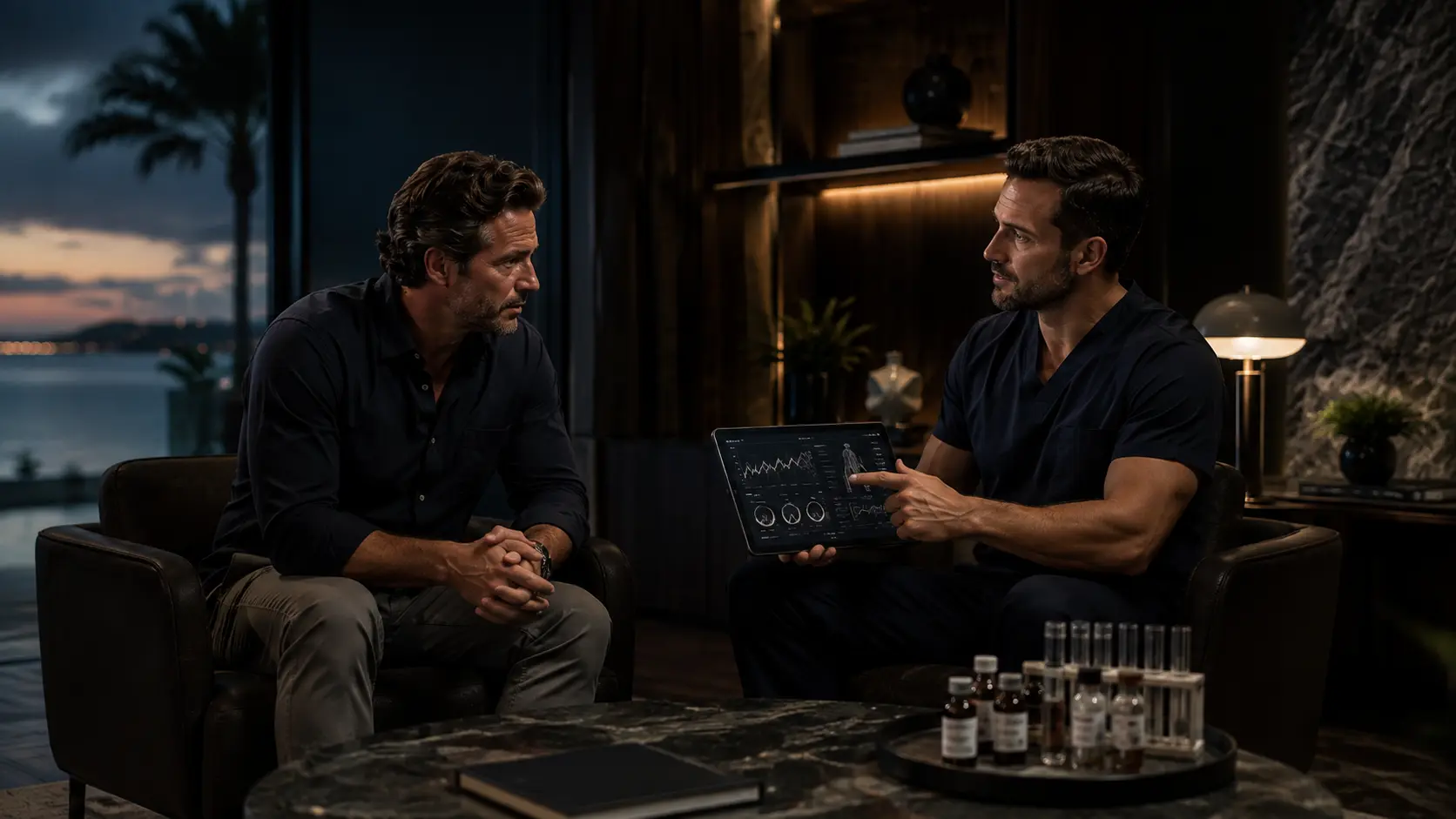
02
WHAT ELSE CAN LOOK LIKE LOW T
Many of the most common “low T” symptoms have multiple possible explanations.
Fatigue can come from poor sleep, sleep apnea, medication effects, metabolic disease, chronic illness, mood disorders, or other hormonal problems.
Sexual desire can change because of relationship factors, stress, medications, depression, sleep, cardiovascular or metabolic health, and sexual-function problems that are separate from testosterone.
Weight gain and declining strength can reflect changes in activity, nutrition, sleep, aging, injury, or metabolic health.
This is exactly why treating a symptom list with testosterone can miss the real problem.
The goal is not to prove that every complaint is hormonal. It is to separate the symptoms that truly track with testosterone from the ones pointing somewhere else.
02
WHAT ELSE CAN LOOK LIKE LOW T
Many of the most common “low T” symptoms have multiple possible explanations.
Fatigue can come from poor sleep, sleep apnea, medication effects, metabolic disease, chronic illness, mood disorders, or other hormonal problems.
Sexual desire can change because of relationship factors, stress, medications, depression, sleep, cardiovascular or metabolic health, and sexual-function problems that are separate from testosterone.
Weight gain and declining strength can reflect changes in activity, nutrition, sleep, aging, injury, or metabolic health.
This is exactly why treating a symptom list with testosterone can miss the real problem.
The goal is not to prove that every complaint is hormonal. It is to separate the symptoms that truly track with testosterone from the ones pointing somewhere else.

03
HOW LOW T IS CONFIRMED
Diagnosis requires more than one number and more than one questionnaire.
Current clinical guidance combines relevant symptoms or signs with consistently low testosterone levels.
The American Urological Association uses total testosterone below 300 ng/dL as a reasonable diagnostic cutoff, but recommends confirming low testosterone with two measurements taken on separate occasions in the early morning.
Additional laboratory evaluation can help determine where the signal is breaking down. For example, luteinizing hormone can help distinguish a primarily testicular problem from one originating farther upstream in the hormonal control system.
Think of the testosterone result as coordinates. It tells you where to start looking—not the entire story of how you got there.
03
HOW LOW T IS CONFIRMED
Diagnosis requires more than one number and more than one questionnaire.
Current clinical guidance combines relevant symptoms or signs with consistently low testosterone levels.
The American Urological Association uses total testosterone below 300 ng/dL as a reasonable diagnostic cutoff, but recommends confirming low testosterone with two measurements taken on separate occasions in the early morning.
Additional laboratory evaluation can help determine where the signal is breaking down. For example, luteinizing hormone can help distinguish a primarily testicular problem from one originating farther upstream in the hormonal control system.
Think of the testosterone result as coordinates. It tells you where to start looking—not the entire story of how you got there.
You have questions, we have answers.
What are the most common symptoms of low testosterone?
What are the most common symptoms of low testosterone?
Can low testosterone cause low libido?
Can low testosterone cause low libido?
Can low testosterone cause fatigue?
Can low testosterone cause fatigue?
Can I have low-T symptoms even if my testosterone is normal?
Can I have low-T symptoms even if my testosterone is normal?
What testosterone level is considered low?
What testosterone level is considered low?
Why is testosterone tested more than once?
Why is testosterone tested more than once?
Request a Consultation