


Healing & Recovery Peptides
Provider evaluation · Appropriate testing · Ongoing monitoring
BPC-157, TB-500 and the Wolverine Blend — the peptides people ask about when an injury healed most of the way and then stopped. Studied for tendon, ligament, muscle and gut repair. Prescribed by a T Clinics provider and compounded by a licensed pharmacy.
BPC-157, TB-500 and the Wolverine Blend — the peptides people ask about when an injury healed most of the way and then stopped. Studied for tendon, ligament, muscle and gut repair. Prescribed by a T Clinics provider and compounded by a licensed pharmacy.
SOFT TISSUE REPAIR
THE WOLVERINE FAMILY
TENDON, LIGAMENT & GUT
PROVIDER PRESCRIBED
SOFT TISSUE REPAIR
THE WOLVERINE FAMILY
TENDON, LIGAMENT & GUT
PROVIDER PRESCRIBED
SOFT TISSUE REPAIR
THE WOLVERINE FAMILY
TENDON, LIGAMENT & GUT
PROVIDER PRESCRIBED
TWO STEPS TO A FREE CONSULTATION
The signs are easy to dismiss. The cause is worth checking.
These are common experiences people bring to us. Two steps, about a minute, and a licensed provider's team takes it from there. Only a provider and lab work can determine what's behind them.
Step 1 of 2
Check off what sounds familiar
Tap every item below that applies to you. Tap it again to unselect. Check off as many as you like, or none at all.
Step 2 of 2
Choose your consultation form
Select a location below, then continue to the short consultation form.
Ready to Talk With Our Team?
Your next step is a consultation with the T Clinics USA team. We’ll use the information you provide to help coordinate the appropriate next step.
It only takes a moment to send your request.
Choose where you'll complete the short consultation form.
This is general information, not a medical assessment or diagnosis. A licensed provider determines whether any condition is present and whether treatment is appropriate. Results vary by individual.
0 items checked off
TWO STEPS TO A FREE CONSULTATION
The signs are easy to dismiss. The cause is worth checking.
These are common experiences people bring to us. Two steps, about a minute, and a licensed provider's team takes it from there. Only a provider and lab work can determine what's behind them.
Step 1 of 2
Check off what sounds familiar
Tap every item below that applies to you. Tap it again to unselect. Check off as many as you like, or none at all.
Step 2 of 2
Choose your consultation form
Select a location below, then continue to the short consultation form.
Ready to Talk With Our Team?
Your next step is a consultation with the T Clinics USA team. We’ll use the information you provide to help coordinate the appropriate next step.
It only takes a moment to send your request.
Choose where you'll complete the short consultation form.
This is general information, not a medical assessment or diagnosis. A licensed provider determines whether any condition is present and whether treatment is appropriate. Results vary by individual.
0 items checked off
The Injury Healed. Then It Stopped.
Healing peptides are the group the recovery world nicknamed after Wolverine — BPC-157, TB-500, and the blend that runs both at once. They are short chains of amino acids your body already uses as repair signals, and they are studied for two jobs: getting repair cells to the damage, and getting blood supply to tissue that is trying to rebuild. Lifters, fighters, weekend athletes and post-op patients all ask about them for the same reason. A tear that healed to eighty percent and quit. A shoulder that is quiet at rest and loud by evening. A surgery that went well and a recovery that flattened out a month later. Below is what each one is actually for, what is known about it, and what isn’t.
The Injury Healed. Then It Stopped.
Healing peptides are the group the recovery world nicknamed after Wolverine — BPC-157, TB-500, and the blend that runs both at once. They are short chains of amino acids your body already uses as repair signals, and they are studied for two jobs: getting repair cells to the damage, and getting blood supply to tissue that is trying to rebuild. Lifters, fighters, weekend athletes and post-op patients all ask about them for the same reason. A tear that healed to eighty percent and quit. A shoulder that is quiet at rest and loud by evening. A surgery that went well and a recovery that flattened out a month later. Below is what each one is actually for, what is known about it, and what isn’t.

WHAT A VENDOR CAN’T SELL YOU
WHAT A VENDOR CAN’T SELL YOU
Anyone Can Ship You The Vial
Anyone Can Ship You The Vial
Anyone Can Ship You The Vial
Nobody in that checkout flow can tell you which peptide matches your injury, what dose matches your body, or whether what is in the vial matches what is on the label. That is the part you are actually paying a clinic for. The peptide is the cheap half.
Nobody in that checkout flow can tell you which peptide matches your injury, what dose matches your body, or whether what is in the vial matches what is on the label. That is the part you are actually paying a clinic for. The peptide is the cheap half.
Nobody in that checkout flow can tell you which peptide matches your injury, what dose matches your body, or whether what is in the vial matches what is on the label. That is the part you are actually paying a clinic for. The peptide is the cheap half.
Talk to a T Clinics provider
Talk to a T Clinics provider
Related Care & Treatments
Peptide Therapy GHK-Cu

Peptide Therapy GHK-Cu
GHK-Cu is the copper peptide behind half the serums on the shelf. Your body makes it, makes steadily less of it after your twenties, and it's asked about for skin, collagen and hair rather than for tendon or joint injury — which is what sets it apart from the rest of the healing peptides. Provider prescribed, pharmacy compounded.
Explore Peptide Therapy GHK-Cu
Peptide Therapy Wolverine Blend
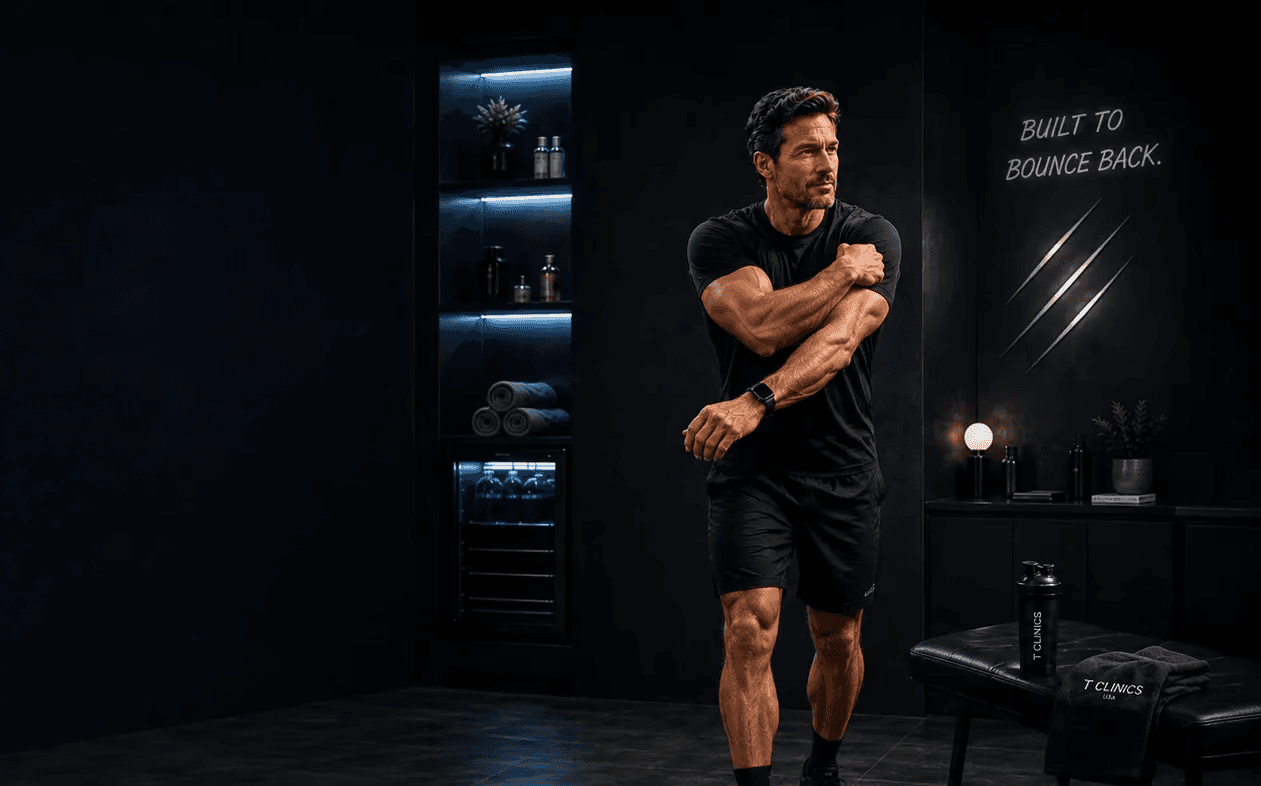
Peptide Therapy Wolverine Blend
When recovery feels like it has stopped moving forward, Wolverine Blend brings BPC-157 and TB-500 together in one compounded injection and one provider-guided plan. It is designed for a different conversation than simply masking discomfort: understanding the recovery goal, the biology being targeted, and what it may take to help you move forward again.
Explore Peptide Therapy Wolverine Blend
Peptide Therapy TB-500

Peptide Therapy TB-500
TB-500 is the peptide the recovery world nicknamed Wolverine. It is a synthetic fragment of thymosin beta-4 — a protein your body already floods into tissue the moment you injure it — and it is studied for two jobs: helping repair cells migrate to the damage, and helping new blood vessels reach tissue that is trying to rebuild. Lifters, fighters and post-op patients ask about it for muscle tears, ligament sprains, and surgeries that healed to a point and then stalled. Below is what is actually known about it, what is not, and how to tell the difference.
Explore Peptide Therapy TB-500
Peptide Therapy BPC-157

Peptide Therapy BPC-157
When a tendon, muscle, joint, or training setback keeps affecting the way you move long after you expected to feel normal again, BPC-157 becomes an interesting recovery conversation. The peptide has drawn attention because of research into biological pathways involved in tissue response, blood-vessel signaling, and recovery—but the real starting point is what you are trying to get back to.
Explore Peptide Therapy BPC-157
The Numbers Worth Knowing
Before you buy a vial from a website
The Numbers Worth Knowing
Before you buy a vial from a website
3
Protocols in this family — BPC-157, TB-500, and the blend that runs both.
3
Protocols in this family — BPC-157, TB-500, and the blend that runs both.
20+
Years these compounds have appeared in tissue-repair research literature.
20+
Years these compounds have appeared in tissue-repair research literature.
0
Research-only vials. Everything here is prescribed and pharmacy-compounded.
0
Research-only vials. Everything here is prescribed and pharmacy-compounded.
How It Works
Recovery Is Not One Job. That Is Why There Is No One “Recovery Peptide.”
How It Works
Recovery Is Not One Job. That Is Why There Is No One “Recovery Peptide.”

01
WHEN THE SETBACK KEEPS SHOWING UP
The injury may be improving while it still changes how you move, train, work, or trust the area.
The shoulder that is quiet at rest but loud by evening. The runner who still shortens the stride without realizing it. The lifter who has technically returned to training but keeps building every session around what the injured area might tolerate. The person who finished rehab but still hesitates before loading the area the way they used to.
That is why “recovery” can be such a vague word. Being out of the acute phase does not always mean being back to normal.
Think of a house after a storm. The emergency may be over, but that does not mean the roof, wiring, walls, and structure all need the same repair. Recovery works the same way: what is still limiting the person matters more than simply asking for “a recovery peptide.”
01
WHEN THE SETBACK KEEPS SHOWING UP
The injury may be improving while it still changes how you move, train, work, or trust the area.
The shoulder that is quiet at rest but loud by evening. The runner who still shortens the stride without realizing it. The lifter who has technically returned to training but keeps building every session around what the injured area might tolerate. The person who finished rehab but still hesitates before loading the area the way they used to.
That is why “recovery” can be such a vague word. Being out of the acute phase does not always mean being back to normal.
Think of a house after a storm. The emergency may be over, but that does not mean the roof, wiring, walls, and structure all need the same repair. Recovery works the same way: what is still limiting the person matters more than simply asking for “a recovery peptide.”

02
DIFFERENT TOOLS FOR DIFFERENT RECOVERY CONVERSATIONS
BPC-157, TB-500, and Wolverine Blend are discussed around different recovery-related pathways and treatment goals.
BPC-157, TB-500, and Wolverine Blend are not three names for the same thing. BPC-157 and TB-500 are discussed around different recovery-related biological pathways, while Wolverine Blend combines both into one compounded blended formulation and one injection at T Clinics.
Think of a toolbox. A hammer, drill, and saw may all belong on the same jobsite, but that does not make them interchangeable. The useful question is not “Which peptide is strongest?” It is which treatment conversation, if any, fits the tissue involved, the stage of recovery, what has already been tried, and the goal the patient is trying to get back to.
None of these options should be presented as a guaranteed healing switch.
02
DIFFERENT TOOLS FOR DIFFERENT RECOVERY CONVERSATIONS
BPC-157, TB-500, and Wolverine Blend are discussed around different recovery-related pathways and treatment goals.
BPC-157, TB-500, and Wolverine Blend are not three names for the same thing. BPC-157 and TB-500 are discussed around different recovery-related biological pathways, while Wolverine Blend combines both into one compounded blended formulation and one injection at T Clinics.
Think of a toolbox. A hammer, drill, and saw may all belong on the same jobsite, but that does not make them interchangeable. The useful question is not “Which peptide is strongest?” It is which treatment conversation, if any, fits the tissue involved, the stage of recovery, what has already been tried, and the goal the patient is trying to get back to.
None of these options should be presented as a guaranteed healing switch.

03
THE COMEBACK SHOULD DRIVE THE PLAN
Getting back under a barbell, trusting a repaired shoulder, or moving through the day without compensating are different goals.
A recovery plan should look different for the golfer protecting an elbow than for someone coming back from surgery or the person whose knee keeps changing the way they walk. That is why T Clinics starts with the setback, timeline, current limitations, rehabilitation, and the real-life goal on the other side.
A website can sell a peptide because someone typed “recovery.” It cannot decide whether the problem needs imaging, more rehabilitation, more time, a different medical evaluation, or whether a peptide discussion belongs anywhere in the plan.
The quotable distinction is simple: do not build the recovery plan around the peptide. Build the peptide conversation around the recovery plan.
03
THE COMEBACK SHOULD DRIVE THE PLAN
Getting back under a barbell, trusting a repaired shoulder, or moving through the day without compensating are different goals.
A recovery plan should look different for the golfer protecting an elbow than for someone coming back from surgery or the person whose knee keeps changing the way they walk. That is why T Clinics starts with the setback, timeline, current limitations, rehabilitation, and the real-life goal on the other side.
A website can sell a peptide because someone typed “recovery.” It cannot decide whether the problem needs imaging, more rehabilitation, more time, a different medical evaluation, or whether a peptide discussion belongs anywhere in the plan.
The quotable distinction is simple: do not build the recovery plan around the peptide. Build the peptide conversation around the recovery plan.
You have questions, we have answers.
What are healing peptides used for?
What are healing peptides used for?
What is the difference between BPC-157 and TB-500?
What is the difference between BPC-157 and TB-500?
Why is TB-500 called the Wolverine peptide?
Why is TB-500 called the Wolverine peptide?
How long before healing peptides do anything?
How long before healing peptides do anything?
Can you take BPC-157 and TB-500 together?
Can you take BPC-157 and TB-500 together?
Are healing peptides injections or capsules?
Are healing peptides injections or capsules?
Do healing peptides help after surgery?
Do healing peptides help after surgery?
Why not just buy peptides online?
Why not just buy peptides online?
Are healing peptides banned in competitive sport?
Are healing peptides banned in competitive sport?
Are these peptides FDA approved?
Are these peptides FDA approved?
Request a Consultation